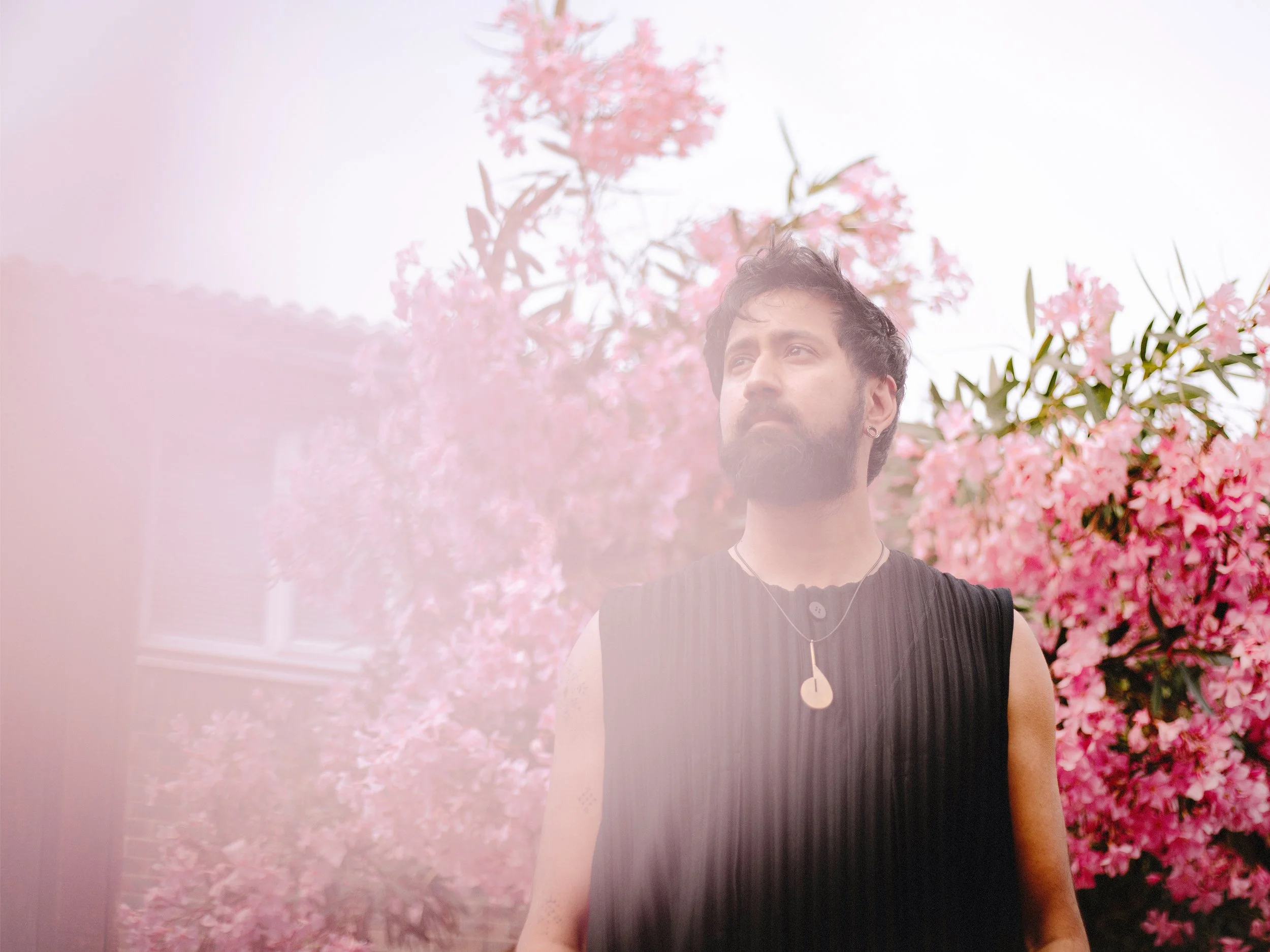
The drum has long been here, beating out our bodily pulse, grooving and pushing forward, communicating from (drum) skin to skin -- a place of ritual and celebration. For lauded drummer, composer and producer Sarathy Korwar, drums are an essential lifeforce, serving as his spiritual and emotional conduit while he blends Indian classical and folk traditions with jazz, electronics, and contemporary music—refusing to be confined to any one cultural or musical box. Community and collaboration are central to his practice, as he believes collective music-making can imagine new futures, treating music as a truly borderless form of expression.
Born in the US before spending his formative childhood years in India and relocating to the UK as a young adult, Korwar has been playing tabla since he was 8 and the drums since 16. He has collaborated with the greats of contemporary jazz, including Shabaka Hutchings, Bex Burch, Alabaster DePlume, Tamar Osborn and Arun Ghosh, as well as with producers Auntie Flo and Hieroglyphic Being. He has also collaborated with Anoushka Shankar and Alam Khan, producing and co-writing Anoushka’s 2025 album, Chapter III: Return to Light, which has earned Sarathy 2 x Grammy nominations - Best Global Music Album, Best Global Music Performance (Daybreak).
Since his 2016 debut album Day To Day, Korwar has developed a beguiling instinct for music that can blend cultures, instrumentation and emotive intent with infectious ease. While Day to Day saw him interpret the folk music of the Indian Sidi community through jazz improvisation and electronics, 2018's My East Is Your West combined Indian classical music with improvisations from the burgeoning London jazz scene. His 2019 release More Arriving won an AIM Award for Best Independent Album and was MOJO's Jazz Album of the Year thanks to its incisive take on cross-cultural identity through Mumbai rap, spoken word and jazz. Along the way, he's also established the UPAJ Collective and worked with Auntie Flo on various projects, each exploring different facets of his boundary-crossing approach.
2022’s most recent record, KALAK, forms a direct connection to There Is Beauty, There Already. “KALAK was a record that engaged with Indofuturism, dreaming of alternate futures through music-making,” Korwar says. “By playing together as a community, we could use our voices and whatever we have on us as a way to create that new future, away from the constraints of standardised western hegemonic rules of melody, harmony, rhythm and song structure. On KALAK, I found myself drawn to the tracks that were mostly percussion-based and that planted the seed to make an entire drum record now. It was a natural extension.”. KALAK was featured as #2 on the GUARDIAN’S Global Albums of the Year 2022.
On his latest album, There Is Beauty, There Already, Korwar pays homage to percussion in his most expansive, experimental and vulnerable fashion yet. Recorded with four drummers over four days at Peter Gabriel's Real World Studios, the album is a continuous 40-minute suite of hypnotic and transcendent drum compositions, beating through a repetitive, circular structure that brings to mind Indian folk music, jazz drum ensembles like Max Roach's M'Boom and the contemporary classical minimalism of Terry Riley and Steve Reich. From the undulating bass tones of the tabla to the tonal varieties of South Indian clay pot ghatam, the snare drum snap of the drum kit, and shades of electronic texture through the Buchla Easel, the album bubbles and flows through a stream of steady rhythm, forever in motion like the ceaseless energy of a river.
Teaming up with KALAK producer and drummer Photay once more, Korwar also enlisted longtime collaborator and percussionist Magnus Mehta and drummer Joost Hendrickx (Kefayah, Eddie Chacon) for a four-day, improvised drum exploration at Real World, funded as part of an Asian Arts Agency Breaking Barriers grant.
"The album is me finding my voice as a composer again and going back to the thing I know best, which is the drum," Korwar explains. "Unlike my other albums that have often engaged with weighty themes like migration, identity and futurism, this is a raw act of placing myself front and centre—letting the drum speak instead."